.png)
The Graph Technical Roadmap
Multi-Service Infrastructure for the Onchain Economy
presents the protocol, products, and economics of The Graph ecosystem in 2026. This roadmap envisions another pivotal year of evolution as the protocol and product suite evolve to meet consumer demand across the blockchain industry, serving developers, data scientists, AI agents, and institutional users with a high-performance, decentralized, and reliability-focused blockchain data infrastructure.
As blockchain infrastructure matures and adoption accelerates, data access requirements have become increasingly specialized. As chains scale to enable faster transactions, developers building real-time applications now need high-speed streaming solutions. Data analysts require SQL-native access for complex queries across multi-chain datasets. AI agents depend on standardized APIs for reliable integration, but require novel protocols to streamline access. Enterprises demand features that support compliance workflows with institutional-grade reliability. No single indexing approach consistently serves all these needs across chains and use cases.
The market requires purpose-built solutions operating within a unified, permissionless, and secure framework. With the launch of in December 2025, The Graph protocol evolved into a modular platform capable of supporting diverse blockchain data services. The developments outlined in this technical roadmap build on Horizon's architecture to deliver these specialized solutions.
This blog is the first in a two-part series. A forthcoming second blog will outline The Graph Foundation's strategic priorities and ecosystem initiatives supporting the successful execution of the technical roadmap.
This roadmap is oriented around three interconnected layers:
- Protocol Layer: The permissionless infrastructure, including staking, payments, and governance, that enables anyone to build and operate a data service on The Graph.
- Product Layer: Specialized data services designed for specific markets and use cases, each following a pragmatic path from development through validation to protocol integration.
- Economic Layer: The mechanisms that align incentives across Indexers, Delegators, and consumers, ensuring value accrual and long-term network viability.
1. Protocol Layer: The Infrastructure
As The Graph ecosystem expands beyond its original Subgraph-centric architecture, the protocol layer is evolving to support a diverse range of data services while maintaining the economic security and coordination that make decentralized infrastructure viable. creates a flexible framework designed to enable multiple specialized data services to operate within a unified economic and security model.
The technical architecture of Horizon introduces three innovations:
- A core staking protocol provides economic security that extends to any data service.
- A unified payments system handles fees across all data services, creating a single economic layer for the entire protocol.
- A framework for permissionless data service development enables new providers to easily integrate into an existing network already running complex data infrastructure.
These architectural improvements unlock the protocol's ability to scale horizontally - supporting new data services as they emerge and enabling existing data services to leverage the unique advantages of The Graph protocol while maintaining the security, reliability, and decentralization that support the core value propositions of The Graph Network.
2. Product Layer: The Growth Engine
The Graph ecosystem is advancing a diverse portfolio of data products designed to meet the evolving needs of developers, applications, and institutions. Each product serves distinct use cases, from real-time blockchain indexing to institutional-grade data access, allowing the ecosystem to deliver value across multiple market segments simultaneously.
As these products mature and demonstrate strong adoption, they follow a path toward deeper protocol integration through Horizon, enabling progressive decentralization that balances innovation speed with network resilience. This evolution reflects the ecosystem's commitment to sustainable growth: delivering practical solutions today while building the decentralized data infrastructure of tomorrow.
Subgraphs
established the original indexing standard for blockchain data and remain foundational to The Graph ecosystem. rely on Subgraphs today, and the successful of users from the hosted service to The Graph Network in 2024 demonstrated that decentralized infrastructure can indeed serve production workloads for blockchain developers.
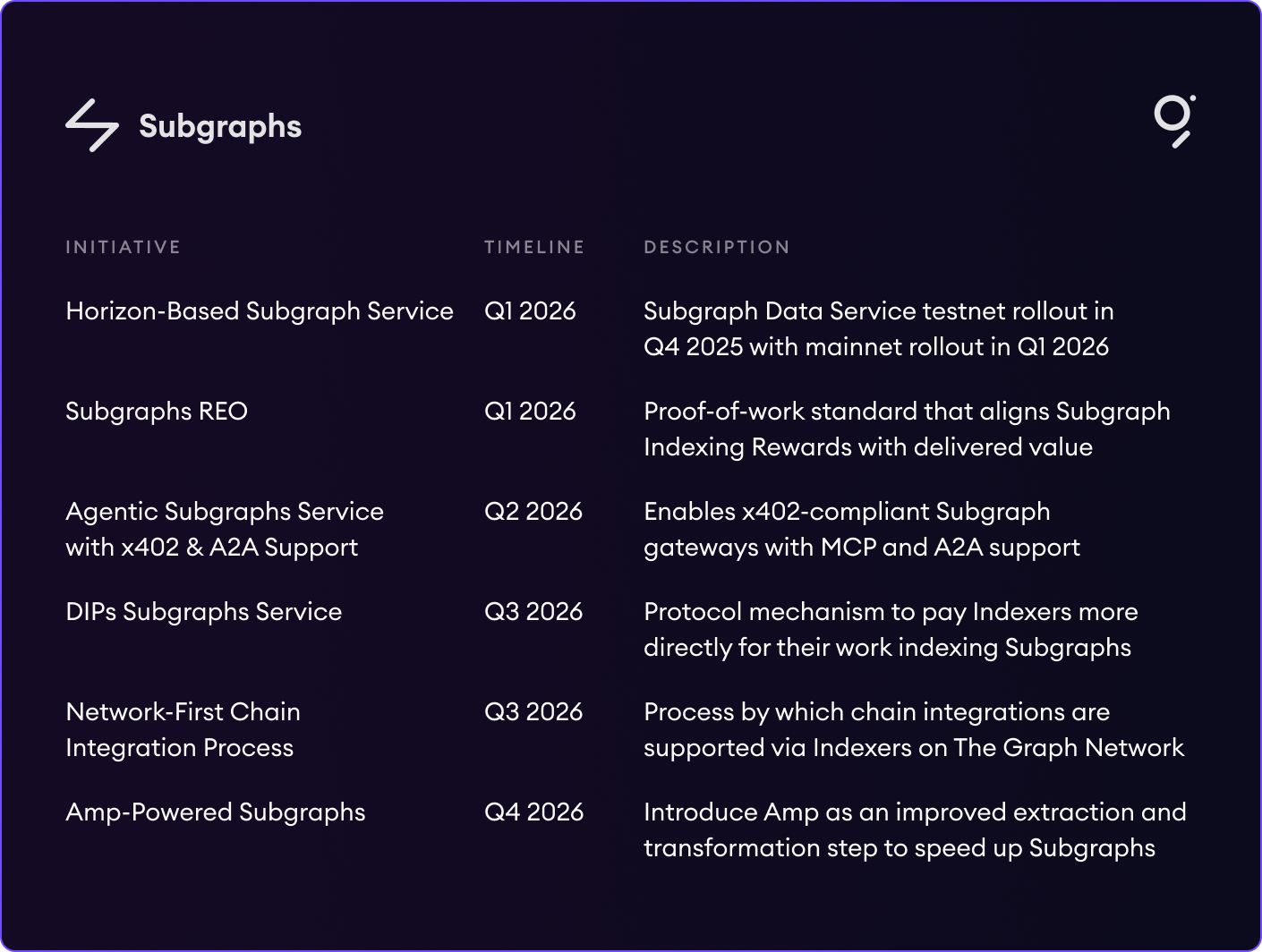
In 2026, Subgraphs will continue serving developers, its core consumers, who rely on this standard, but the focus will deepen in two ways. First, The Graph will place more emphasis on improving quality and support to better serve small-to-medium-sized projects through cost and scaling efficiencies. This process includes network-first , the (REO), and (DIPs) that all aim to ensure Indexers are appropriately incentivized to serve Subgraph users. Second, there will be added focus for AI compatibility to introduce Subgraph-compliant gateways as well as and Subgraph A2A integrations, making blockchain data queryable through natural language interfaces in tools like Claude, Cursor, ChatGPT, and a host of other emerging AI interfaces. Integrating means AI agents will be authorized to autonomously query the network and pay per-query with no setup keys in the Studio.
Blockchain JSON-RPC Data Service
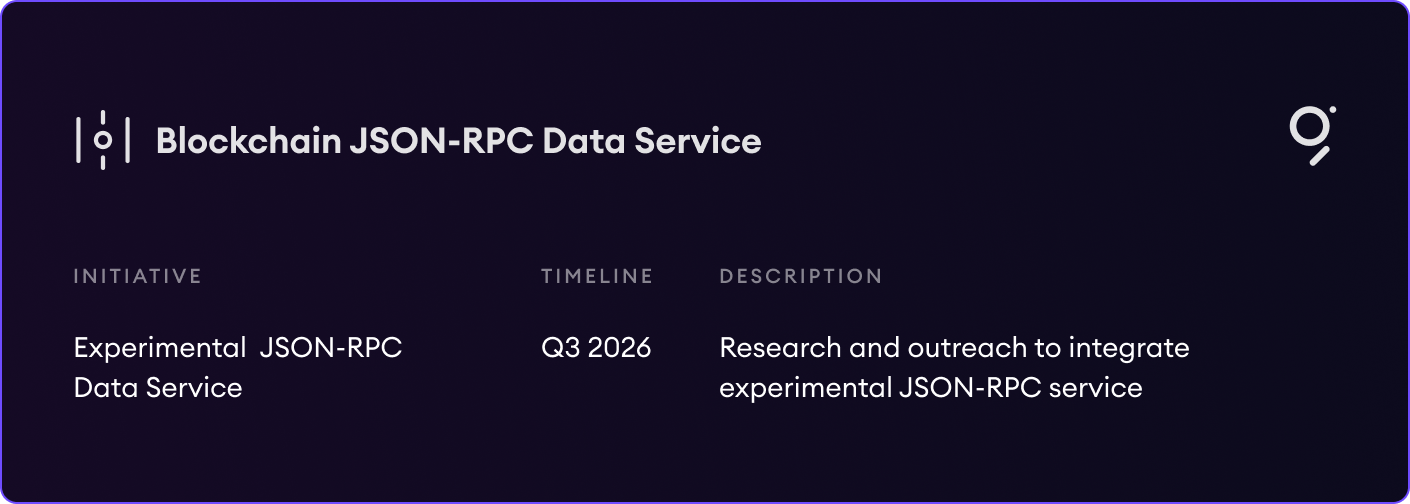
Expanding into blockchain JSON-RPC access represents a natural evolution of The Graph developer platform. While the protocol has historically specialized in indexed data queries, developers increasingly expect unified infrastructure that supports both advanced indexing and core blockchain read/write functionality. Enabling seamless access to these capabilities, whether through partnerships, integrations, or native services, strengthens The Graph’s role as a full-stack data layer for web3 applications.
The Graph ecosystem is well-positioned to support this expansion. Many infrastructure providers within and adjacent to the network already operate RPC capacity at scale. Aligning these capabilities with The Graph’s payment, security, and distribution frameworks creates new coordination opportunities across the ecosystem while improving the developer experience. This roadmap intentionally leaves room for multiple RCP implementation paths as the network validates the best structure for long-term growth.
Substreams
provides high-performance, low-latency blockchain data streaming designed for users with demanding technical requirements. The service has gained adoption among prominent , DePIN and , , and traditional financial institutions, particularly those requiring real-time transaction processing on like Base, BSC, and Solana.
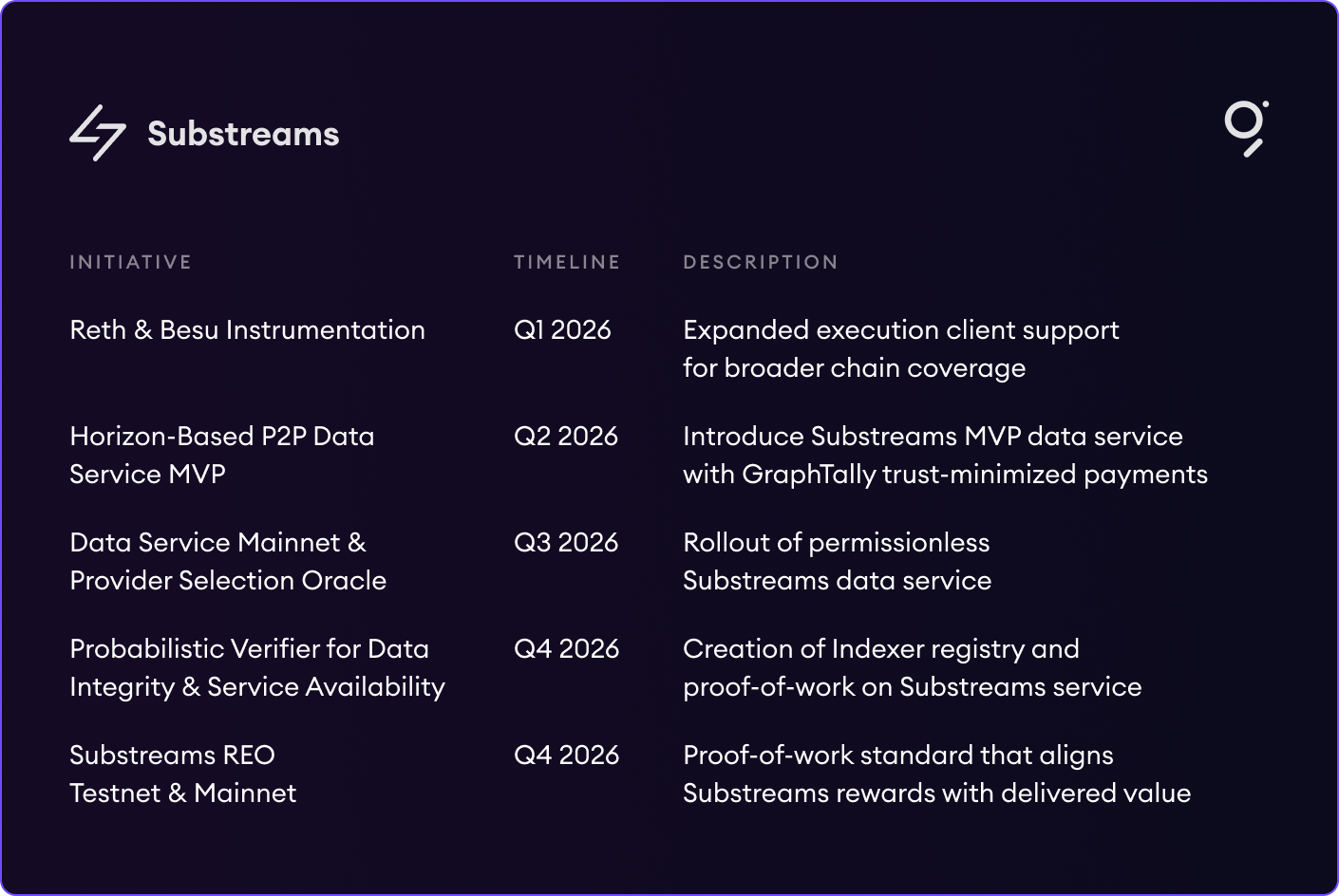
Development priorities for Substreams in 2026 focus on improving developer experience, expanding chain coverage, reducing streaming latency, and progressing toward integrating Substreams into The Graph protocol via Horizon. These improvements aim to strengthen Substreams' position as a valuable infrastructure layer for applications and institutions that require streaming blockchain data at scale.
Token API
Many blockchain applications, such as wallets, block explorers, marketplaces, and analytics platforms, require the same fundamental data: token balances, prices, transfers, swaps, and NFT metadata. While Subgraphs excel at custom indexing for protocol-specific use cases, these standardized data needs don't require custom development infrastructure.
The Graph addresses this gap by providing pre-indexed, production-ready access to common token data information across multiple chains. Built on , the Token API service delivers reliable, standardized data without requiring teams to build or maintain custom indexing solutions. Token API currently supports 10 chains, with continued expansion and feature development planned for 2026.

Tycho
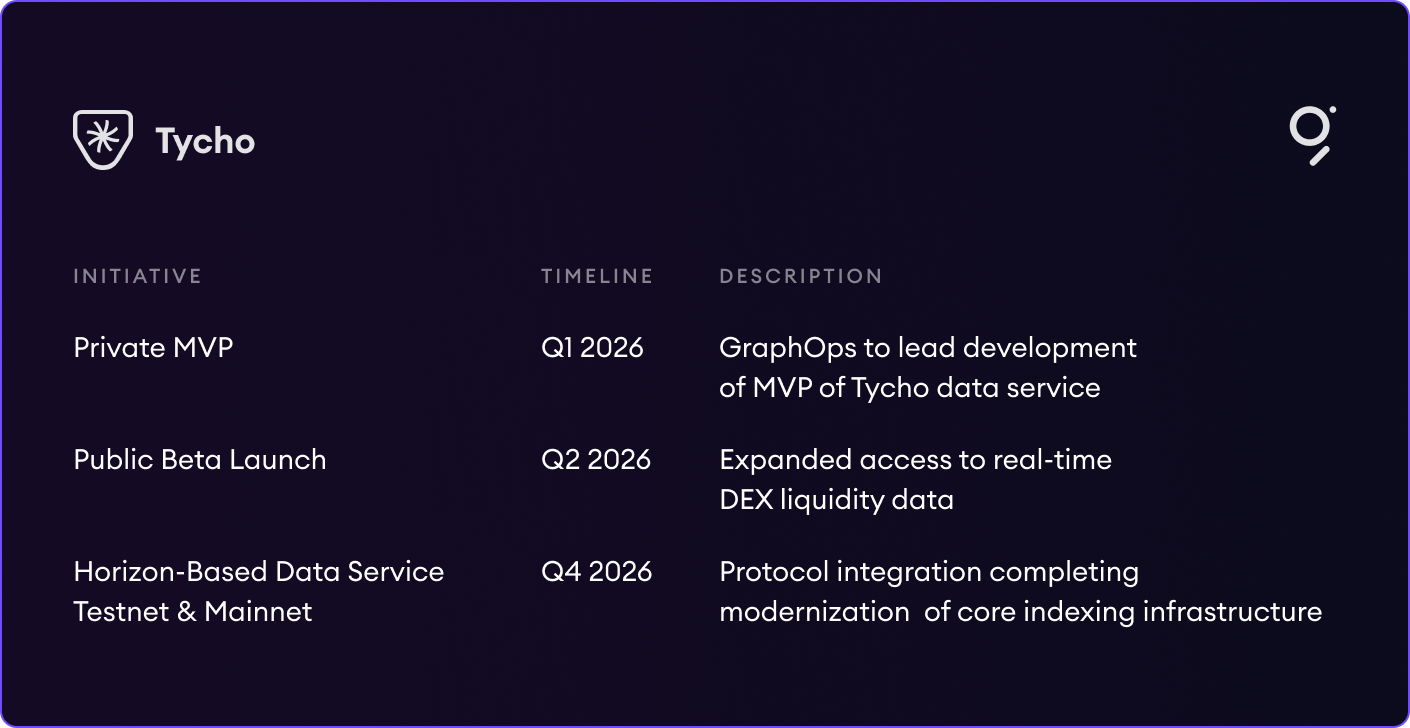
The initiative extends this roadmap deeper into DeFi by making onchain liquidity easier to access, understand, and use in real time. Instead of forcing teams to run their own nodes or decode complex protocol logic, Tycho tracks how liquidity changes across decentralized exchanges and delivers live updates through a simple streaming interface. It provides a single, consistent way to get prices and quotes across many DEXs, helping trading systems, solvers, and applications tap into more liquidity with far less setup and ongoing maintenance.
Also built on , Tycho removes much of the operational burden that slows teams down today. It keeps data accurate even when blockchains reorganize, updates quickly as markets change, and works across chains without requiring specialized infrastructure for each one. By lowering the barrier to high-quality liquidity data, Tycho helps market participants access deeper liquidity, improve execution, and build faster-moving products as onchain markets continue to grow.
Amp
introduces a new class of data infrastructure to The Graph ecosystem, adding a blockchain-native database purpose-built for institutional scale, trust, and performance. Designed to replace RPC-heavy architecture and brittle ETL (i.e., extract, transform, and load) pipelines, transforms raw onchain activity into verifiable intelligence using SQL to enable teams to analyze, audit, and act on blockchain data in real-time across multiple chains.
With built-in lineage, audit-ready provenance, and enterprise-grade deployment options, Amp delivers the speed and consistency required for regulated environments, from payments and treasury oversight to risk management and AI-driven automation. As financial systems continue moving onchain, Amp ensures The Graph offers an infrastructure-grade solution that makes blockchain data reliable, auditable, and usable at global financial scale.

3. Economic Layer: Sustainability
The Graph protocol's long-term viability depends on sustainable economics that deliver value to all network participants: Indexers running infrastructure, Delegators securing the network, developers and enterprises consuming data, and the broader ecosystem. Horizon and the expanded product suite are designed to strengthen this economic base.
Network Economics
The Graph protocol operates as a two-sided market connecting data providers to data consumers. Historically, the protocol's incentive mechanisms proved effective at scaling the supply side, attracting Indexers to The Graph Network, but demand was constrained by a few factors, including a relatively small - but growing - addressable market of blockchain developers.
Over the coming year, this supply-demand imbalance is expected to be addressed on both sides. On the demand side, Horizon unlocks new potential for an expanded product suite to serve a much larger addressable market and, consequently, may attract more supply-side participation and economic benefit. Meanwhile, JSON-RPC, Subgraphs, and Token API are expected to deepen network usage from developers and AI agents, while new growth is likely to come from analysts, solvers, and institutions attracted to expanded offerings such as Substreams, Amp, and Tycho.
The fundamental value accrual thesis is straightforward: more data services generate more protocol activity. More query volume means more fees flowing through the network. More fees can drive token burns. More data services require more staked GRT. And, as the product suite expands and adoption grows across these various users and use cases, this economic flywheel is expected to accelerate.
As part of this continued evolution, The Graph will offer compliance-ready products, on-premises deployment options, and dedicated support for the specific requirements of enterprise and institutional users. The DTCC's demonstrates how major financial institutions are already building with technology from The Graph, and this enterprise momentum is expected to accelerate as products like Amp and Substreams demonstrate increased value to these participants in the market.
On the supply side, the ecosystem can expect three major changes. The first is that issuance is expected to be redirected across multiple data services. Second, REO establishes a clearer proof-of-work standard to ensure that Indexing rewards correlate with actual value delivery rather than passive token holding. The current vision is to introduce REO for both Subgraphs and Substreams over the coming year. Third, the introduction of Indexer Payments (or DIPs) will provide a flexible protocol mechanism for consumers, chains, and ecosystem participants to incentivize Indexers.
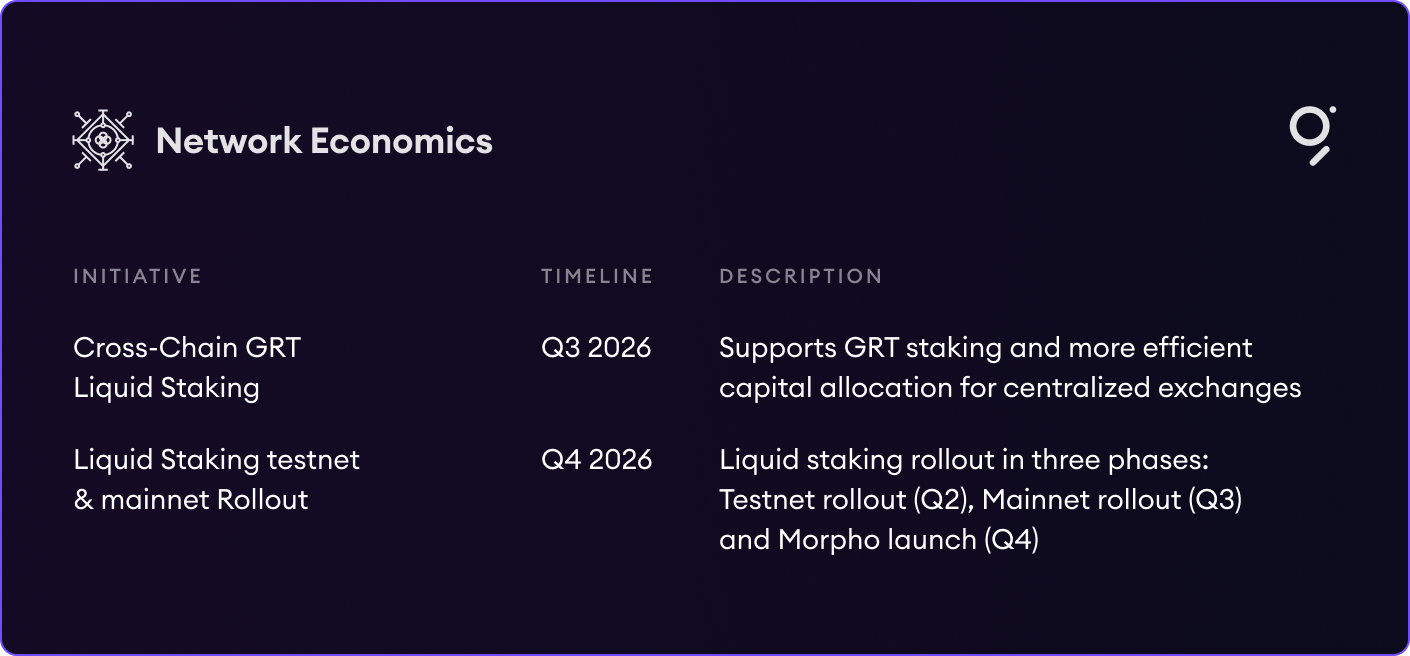
The Graph has also been working on additional initiatives that help increase the utility of GRT. For example, the ecosystem recently added Chainlink’s CCIP protocol, and now GRT is bridged to Arbitrum, Base, and Avalanche with plans to extend to Solana in 2026. The ecosystem is also working on a Liquid Staking Initiative that aims to make delegation more accessible for token custodians by offering a native API in a single interface for centralized exchanges to improve the UX for their users.
The Graph Technical Roadmap 2026
Q1 2026
- Horizon-Based Subgraph Service Mainnet rollout
- Rewards Eligibility Oracle proof-of-work standard
- Expanded execution client support for broader chain coverage of Reth & Besu instrumentation
- Token API Production-grade latency on 10 networks with continued chain expansion
- Private MVP of Tycho data service
Q2 2026
- x402-compliant Subgraph gateway with MCP and A2A support enabled
- Substreams MVP data service with GraphTally trust-minimized payments, Horizon-based P2P data service introduced
- Public Tycho beta launch
- Testnet rollout of liquid staking
Q3 2026
- DIPs Subgraphs Service
- Network-First Subgraph Chain Integration Process
- Experimental JSON-RPC Data Service research
- Substreams Data Service Mainnet & Provider Selection Oracle rollout
- Token API real-time token pricing with DEX and chain expansion
- Mainnet rollout of liquid staking
Q4 2026
- Morpho launch of liquid staking
- Amp-Powered Subgraphs for data extraction and transformation
- Substreams probabilistic verifier for data integrity and service availability
- Substreams REO testnet and mainnet launch
- Amp SQL Platform development
- Amp verifiable raw blockchain data release
- Amp Horizon-based data service testnet and mainnet launch
- DIPs Amp service
The Path Forward
The Graph Network is a battle-tested and mature blockchain infrastructure continuously demonstrating reliability across applications and blockchain networks. The 2026 technical roadmap advances the protocol vision toward emerging market demand: as blockchain adoption accelerates, different users require different access to data.
No single approach can serve the evolving demands for blockchain data, but Horizon helps address this architectural challenge by enabling The Graph. The product strategy outlined in this roadmap targets distinct market segments, offering unique value, while contributing to the protocol's overall growth and sustainability. More data services available on The Graph generate more network activity and high-quality complementary services.
Stay informed as these initiatives progress and new developments emerge! Subscribe to the r and join the next quarterly call for a deeper look at this technical roadmap and the Foundation’s strategic vision. Sign up for The Graph to receive monthly updates, and track progress in real time by visiting the .

About The Graph
The Graph is a suite of blockchain data infrastructure products that extract, process, and deliver scalable blockchain data solutions across 60+ networks. The Graph enables application developers, data analysts, AI agents, and enterprise teams that need structured, real-time access to blockchain data. Products include Subgraphs, Firehose, Substreams, and Amp. As of early 2026, The Graph has served over 1.27 trillion queries to more than 75,000 projects, powered by a network of independent Indexers around the world.
Follow The Graph on , , , and . Join the community on The Graph’s , join technical discussions on The Graph’s .