6 minutes
Subgraph Curation
Curation is how a published Subgraph attracts Indexers on The Graph Network. When you curate, you deposit GRT as signal on a Subgraph. Signal tells Indexers that the Subgraph is worth indexing, and on networks with indexing rewards it directs a share of those rewards to the Indexers that serve it.
Anyone can curate. Most of the time, the first Curator is the Subgraph’s own developer, who adds signal when publishing so that Indexers pick the Subgraph up. Third-party Curators can also signal on Subgraphs they expect to drive query volume.
How Signal Attracts Indexers
Before anyone can query a Subgraph on The Graph Network, an Indexer has to sync it. Indexers decide what to sync based largely on curation signal, which they can see in Graph Explorer.
- Networks with indexing rewards: Indexing rewards, funded by GRT issuance, are distributed to Subgraphs in proportion to their signal. More signal means more rewards for the Indexers that serve your Subgraph, which attracts more of them. To check if a network has indexing rewards, check the Supported Networks page.
- Select community-supported networks: On some networks without indexing rewards, community Indexers have committed to sync every published Subgraph above a set signal threshold. For example, InfraDAO supports published Subgraphs with 500+ GRT in signal on select chains.
- Other networks without indexing rewards: Signal does not attract Indexers, because there are no rewards to direct. Check your Subgraph’s indexing reward eligibility and network support before you add signal.
How Much Signal to Add
Use this table to choose a signal amount for your Subgraph. More signal attracts more Indexers, which gives your Subgraph better redundancy and quality of service. These amounts are guidelines, not guarantees. The number of Indexers your Subgraph attracts also depends on query volume and overall network activity.
| Signal | When to use it | What to expect |
|---|---|---|
| 500 GRT | Select community-supported networks | Meets the community Indexer threshold on networks that offer it |
| 1,000 GRT | Minimum for networks with indexing rewards | Attracts 1-2 Indexers, a starting point for new or low-volume Subgraphs |
| 3,000 GRT | Minimum for 3+ Indexers | Covers the three Indexers a Gateway selects per query, so one outage doesn’t leave your Subgraph unserved |
| 10,000 GRT | Production Subgraphs | Robust multi-Indexer support with redundancy well beyond three Indexers |
How to Add Signal
When You Publish
Subgraph Studio lets you add signal in the same transaction that publishes your Subgraph, which saves gas. See Publishing a Subgraph.
From Graph Explorer
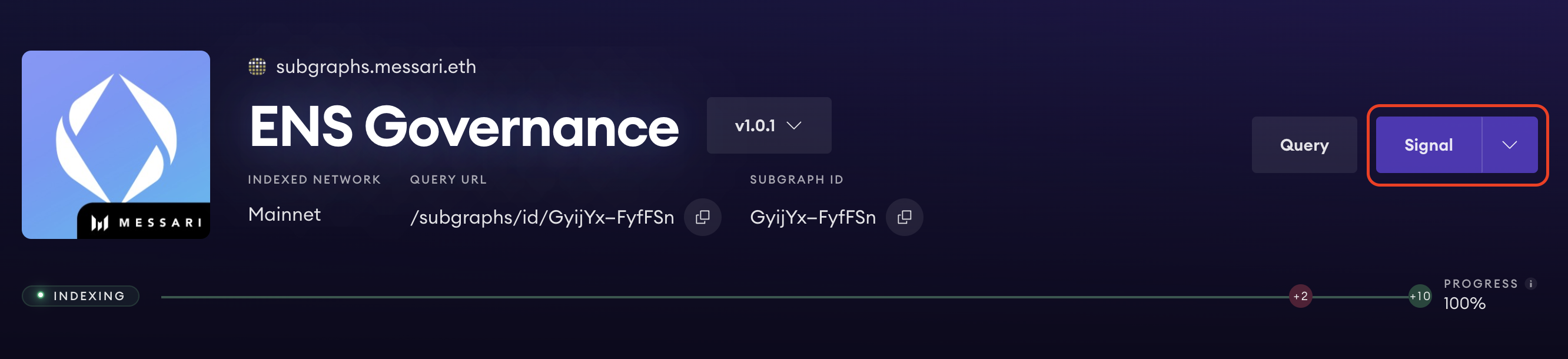
You can signal on any published Subgraph, including your own, from its page in Graph Explorer. Curation happens on Arbitrum One, so you need GRT and a small amount of ETH on Arbitrum One. See Getting GRT and Bridging GRT.
Auto-Migrate vs. a Specific Version
When you signal, choose how your signal behaves when the developer publishes a new version:
- Auto-migrate: Your signal moves to the newest version each time the developer publishes one. This keeps your signal on the version Indexers are serving. The curation tax applies to signal each time it migrates.
- Specific version: Your signal stays on the version you chose. This is useful when several dapps rely on one Subgraph and some prefer an older, well-tested version. To move to a newer version later, withdraw and signal again, which incurs the curation tax on the new deposit.
Curation Costs
Curation actions come with a tax that happens each time signal is added to a Subgraph. Removal of signal is not taxed. Because migrations are taxed, publish new versions only when you need to. Frequent updates cost both the developer and Curators who use auto-migrate.
| Action | Cost |
|---|---|
| Signal on a Subgraph (initial or added signal) | 3% curation tax, burned |
| Signal migrates to a new version (auto-migrate) | 3% curation tax on the migrated signal, burned. When publishing a new version, the Subgraph owner funds part of the tax on auto-migrating signal |
| Withdraw signal | No tax, only gas |
Curation Rewards
Curators mint curation shares, called Graph Curation Shares (GCS), when they signal. Curators earn a share of the query fees their Subgraph generates: 10% of query fees go to Curators, pro-rata to their curation shares. This percentage is subject to governance.
Curation on Arbitrum One uses a flat bonding curve (GIP-0039). Shares are minted at a constant price, so there is no advantage to signaling early, and you get back the GRT you deposited, minus the curation tax, when you withdraw.
Withdrawing Signal
You can withdraw your signal at any time from your profile in Graph Explorer. Unlike undelegating, there is no waiting period, and no tax is charged on withdrawals. After you withdraw, Indexers may keep indexing the Subgraph, but with less signal there is less incentive for them to do so.
If a Subgraph is deleted, Curators can still withdraw their GRT, but GRT is not automatically returned to the Curator’s wallet. See Deleting a Subgraph.
Curation Risks
- Curation tax: Every deposit and migration burns 3% of the signal, so moving signal often reduces your GRT.
- Query fees can be low: The query market is still young, and returns from query fees may be lower than you expect.
- Subgraphs can fail: A Subgraph can fail due to a bug, and a failed Subgraph does not accrue query fees.
- If you signal with auto-migrate, your signal moves to the fixed version when the developer publishes it, which incurs the curation tax.
- If you signal on a specific version, you need to withdraw and signal on the new version yourself, which incurs the curation tax on the new deposit.
Curators cannot be slashed. For a network role with a different risk profile, see Delegating.
Curation FAQs
1. What % of query fees do Curators earn?
10% of a Subgraph’s query fees go to its Curators, pro-rata to their curation shares. This percentage is subject to governance.
2. How do I decide which Subgraphs to signal on?
Look for trustworthy Subgraphs that drive, or are likely to drive, query volume. A trustworthy Subgraph is complete, accurate, and supports a dapp’s data needs. A poorly architected Subgraph may need to be republished or may fail, so review its code and architecture. Graph Explorer metrics such as past query volume and the identity of the Subgraph developer can also help.
3. What does it cost when a Subgraph is updated?
If your signal auto-migrates, the 3% curation tax applies to the migrated signal, and the Subgraph owner funds part of it. If your signal is on a specific version, nothing happens until you choose to move it. See Curation Costs.
4. How often should I update my Subgraph?
As rarely as you can. Each new version taxes auto-migrating signal, which costs both you and your Curators.
5. Can I sell my curation shares?
No. Curation shares can’t be bought or sold like other ERC20 tokens. They can only be minted (when you signal) or burned (when you withdraw). When you withdraw on Arbitrum One, you get back the GRT you deposited, minus the curation tax.
6. Why isn’t my Subgraph being indexed after I added signal?
Check that your Subgraph is eligible for indexing rewards or is on a community-supported network, and that you’ve added enough signal for that network (see How Much Signal to Add). Signal on networks without indexing rewards or community support does not attract Indexers.
7. Am I eligible for a curation grant?
Curation grants are decided case by case. If you need help with curation, send a request to [email protected] and include the Subgraphs you need help with.